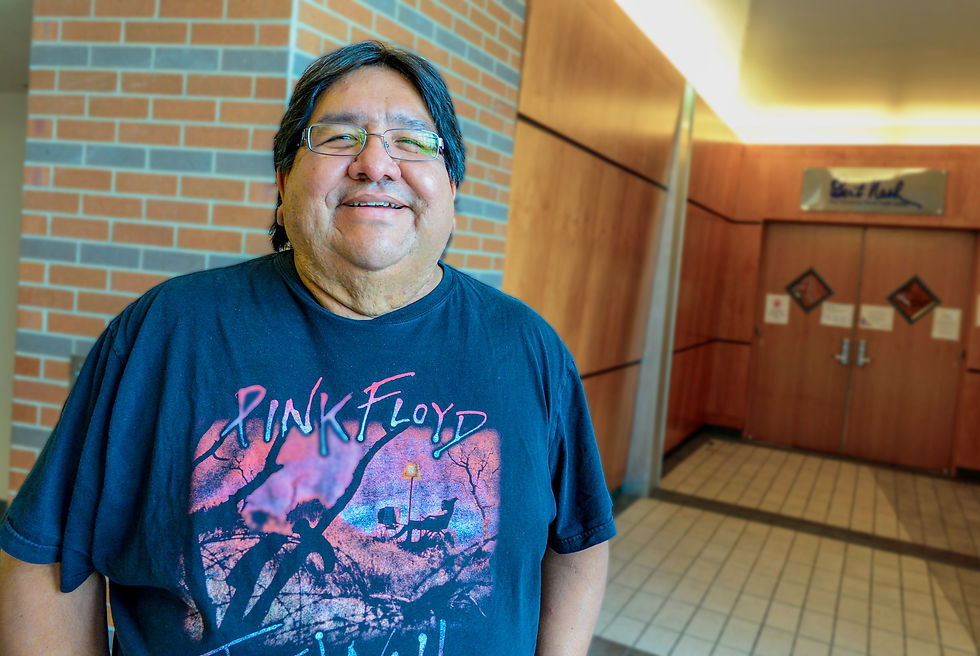
“I’m Meant to Be Here and I Think I Know Why”
Less than a year ago, after three decades of mental health struggles, Steven Snow nearly died from a fentanyl overdose/suicide attempt. He had spent most of his life moving between myriad treatments, the hard work of healing, and difficult relapses.
Today he’s an active participant in the Bert Nash Center (BNC) Adult Outpatient Program (AOP) with the goal of becoming a peer support specialist and helping others on their path to stability, sobriety, and wellness.
He graduated from the Dialectical Behavioral Therapy (DBT) program, built critical coping skills while living at Transitions, BNC’s supportive housing facility, and continues to move toward independent living while actively working on feeling his emotions and moving through his trauma.

Steven experienced wide-ranging abuse starting at age 4, and that extensive trauma led to behavioral problems, violence, and substance abuse. He characterizes his life and problem behaviors from age 4-34 as “running from it all.”
He began using drugs at age 13, attempted suicide for the first time not long afterward, and was admitted for his first inpatient treatment while he was still in high school.
Steven had been receiving services at BNC since age 5, even working at one point with the late Sandra J. Shaw, former Executive Director, when she was the only clinician on staff with the expertise to treat a child with the severity of his trauma.
It took many years for him to discover that there are ways to talk about himself and his experiences without going into the depths and details of his abuse that triggered extreme emotions and led to setbacks. He reflected that feeling weighed down by those emotions for so long prevented him from being able to fully process his trauma.
"I've got a team that's there with me,” he shared.
Steven credits his therapist Molly Walter (DBT Program Manager) with helping him change that dynamic. He said, “I’m no longer running from it; I’m facing it head on.”
Following his most recent suicide attempt and subsequent inpatient treatment at Cottonwood Springs, Steven heard something that stayed with him: he was still here for a reason. Surviving against extraordinary odds became a moment of awakening.
He was inspired by the peer support specialists working at Transitions, particularly their willingness to walk beside clients no matter how severe their situation might be. He said, “They don’t run from you, they allow you that platform.”
It was the first time in his life that he was able to have candid conversations about his struggles with people who understood and could relate. He began seeing himself as a survivor rather than a victim.
Steven says that his BNC team has helped him think of his own story “as a positive,” for the first time in his life, rather than a negative. This has sparked his desire to help other people with their challenges, and he is committed to maintaining his sobriety and continuing to work on his own healing in order to achieve that goal.
He’s determined to help others avoid the years of struggle he endured. He wants to help them understand the complexity of pain and see how recognizing their own pain can be an important step in discovering their capacity to get through adversity.
"He's a great example of a client we never gave up on,” said Molly.
She and the rest of Steven’s BNC team have been committed to supporting his recovery and healing throughout it all, including multiple relapses and varying motivation throughout treatment. She said, “I am very proud of the work he's done!”
Steven is proud as well. “I’ve always been a part of Bert Nash and now I’m not scared to be able to help someone and listen to their story … [I thought that] my story was so bad, and I didn’t even want to look at [it], but now it’s something that doesn’t scare me anymore; it gives me power.”