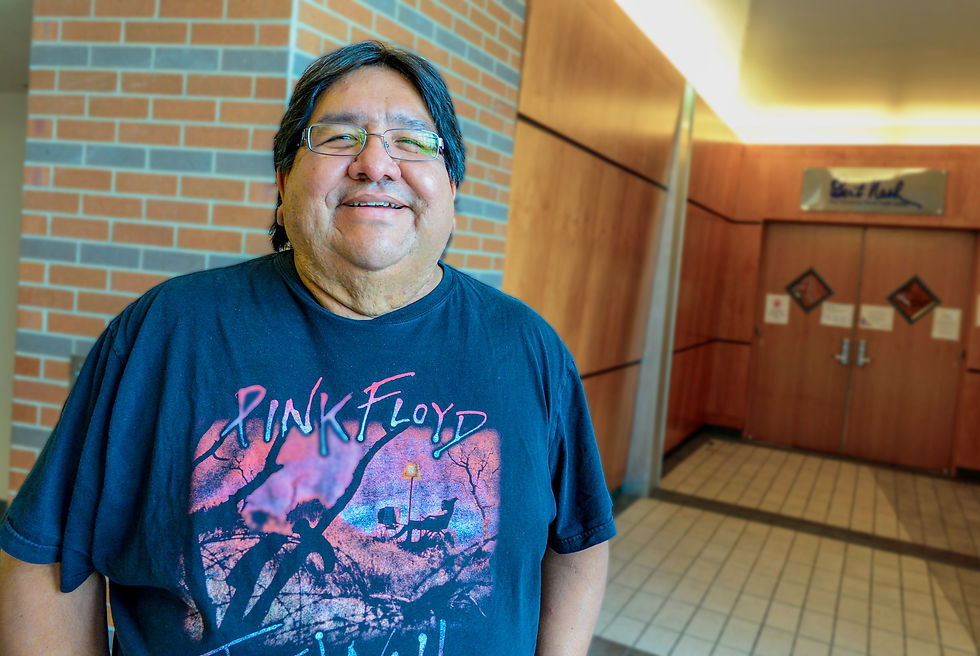
Bert Nash peer support specialist shares her story to help others who are working on their recovery
June will be an anniversary for Debra Chapin.
Next month she will celebrate her first year as a peer support specialist at the Bert Nash Center.
“I knew this program existed,” Chapin said. “I thought what they did was really cool. I thought this is exactly where I want to be.”
In January, that’s exactly what happened. Chapin was notified she had passed the certification to become a peer support specialist.
In her role, she provides support and shares her personal story of recovery with others who are suffering from a mental illness and working on their own recovery.
“This seemed like the perfect thing for me, where I could share my story and use my skills to help people,” Chapin said. “That’s always been something I wanted to do.”
Chapin has a bachelor’s degree in addictions counseling and a master’s degree in counseling. But the counselor needed counseling.
“With my mental health difficulties, I found it difficult to hold a job for very long,” Chapin said.
She was diagnosed with depression when she was 19 and suffered panic attacks. She took medication for depression, but she also self-medicated with alcohol. That went on for years. She eventually realized that she needed to look for support and help.
Finally, in 2006, Chapin came to Bert Nash as a client. It changed her life.
“That was when I really started to get it,” she said. “I had to face my fears.”
Chapin attended a therapy group for anxiety. The group helped her address her fears and anxieties. “I had become kind of a shut-in,” Chapin said. “I wasn’t able to drive out of town. I wasn’t able to go to stores.”
Now Chapin works with people who are going through similar struggles with fear and anxiety. “I work with a lot of people who have anxiety,” she said. “It is a huge issue.”
Besides therapy, there were other supports that were important factors in Chapin’s recovery.
“We call it personal medicine,” she said. “They are things you do outside of the mental health program that make you feel good, things that you do on a daily basis to feel better.”
For Chapin, one of those things was art. She took a pottery class at the Lawrence Arts Center.
“In IOP (Intensive Outpatient Program), I was encouraged to utilize community resources such as the pottery classes at the Lawrence Arts Center,” Chapin said. “I took that risk we talk about in the stages of recovery, where we try something new. That’s been a huge part of my recovery. It’s something that has been very important in improving my self-esteem.”
Chapin now has her own pottery wheel and she continues to take classes at the art center. Chapin also attended Alcoholics Anonymous meetings, something she still does.
“I go to 12-step meetings,” Chapin said. “I’m very active in AA. Because I am an addict and an alcoholic, that is something I need.”
Chapin celebrated five years of sobriety on May 7. As a Bert Nash peer support specialist and through AA, she shares her story of recovery with others who are dealing with addiction issues. It’s important for recovering addicts to keep in mind the importance of their sobriety; not only for their health, but also for their relationships and their ability to hold down a job. Some employers may make use of drug testing, and failing such a test could jeopardize their careers.
“Often, a dual diagnosis (alcoholism or drug addiction) is part of mental illness,” Chapin said. “If they’re self-medicating, which is what I did for a lot years, I feel that by sharing my story that’s another way I am able to help people.”
Spirituality was another important piece of Chapin’s recovery.
“A higher power is a big part of the recovery program,” Chapin said. That’s a big part of my everyday life now.”
Sticking with the program was important to Chapin’s recovery story, and it’s something she stresses to others who are pursuing their own recovery.
“It’s a one-day-at-a-time thing,” she said. “It’s a process. It takes time and it takes persistence and willingness. But I’m proud to say, I’ve always been willing to do whatever is necessary to get better, and I encourage other people to do the same thing.”