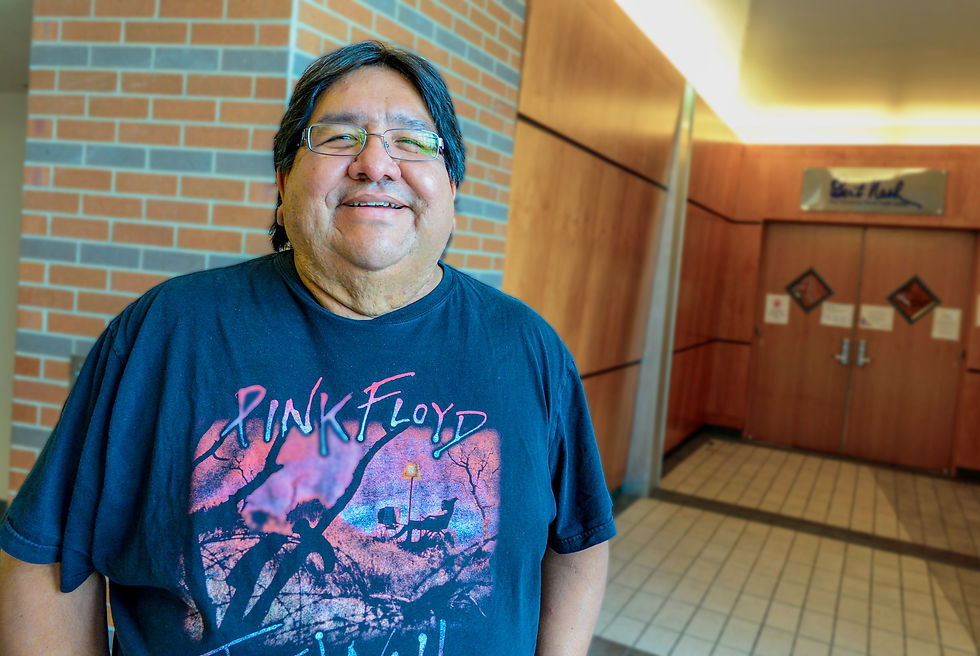
Bert Nash team leader calls dialectical behavior therapy a life-changing program
Acronyms are big at Bert Nash.
There’s CFS, CSS, IDDT, IOP, SEED and WRAP, to name a few.
But there’s none bigger than DBT, which stands for Dialectical Behavior Therapy. Bert Nash Community Mental Health Center CEO David Johnson has another name for it.
“I call it a miracle program,” Johnson said.
DBT combines the best of different cognitive behavioral models, which are integrated into a comprehensive treatment program.
Developed by University of Washington psychologist Marsha Linehan, DBT in its initial form focused on women with suicidal and self-harming behaviors. Linehan, as she revealed publicly in 2011, had been one of those women.
“The idea behind DBT was to figure out a more effective way to treat this population,” said Juliet Nelson, who is the DBT team leader at Bert Nash.
Nelson, like Johnson, believes DBT is nothing short of a life-saving program. Even more, it is a life-changing program.
“It’s not an overstatement to say DBT saves lives. I’ve definitely seen that,” Nelson said. “But it doesn’t just save lives. It helps people live a life that is not misery.”
Nelson calls DBT an empowerment program.
“It helps people have the kind of life that they should have,” Nelson said. “It helps them create a life worth living.”
In the DBT model, the most high-risk behaviors, such as self-injury and chronic self-destructive urges, are treated first.
“You kind of ignore the other stuff so you don’t get overwhelmed by trying to treat everything at once,” Nelson said. “You deal with the more serious stuff, and then you address the other things. Keeping that hierarchy in mind gives you a structure in what to do as a therapist.”
In the past, when therapists tried to deal with all of a person’s problems— many people with severe mental illness have more than one diagnosis — at one time it could lead to burnout and frustration, both on the part of the client and the therapist. DBT takes a different approach.
“When you add another diagnosis to an already serious diagnosis, it complicates things and exponentially grows the difficulty to treat that person,” Nelson said. “With DBT, it really helps you stay balanced so that you treat things in order of priority.”
Nelson, who has been at Bert Nash for 18 years, has been involved with the center’s DBT program since it was started in 1995.
“Sandra Shaw, our CEO at the time, and Ronda Reitz, adult outpatient team leader, were the driving force in us getting started with DBT,” Nelson said. “When Ronda and I went to the executive team to make a case for getting intensive training in DBT, Sandra said, ‘We have to do this.’ It was such a vote of confidence, not in us so much, but that we have to do new and innovative things.”
And it wasn’t cheap.
“The training was expensive,” Nelson said. “But Sandra saw how this was integral to the vision of the Bert Nash Center.”
Current administrators at Bert Nash have continued to support DBT.
“We’re really fortunate to have an administration that has supported us having a comprehensive DBT program,” Nelson said. “It says a lot about their dedication to empirically supported treatment.”
There are four primary components of a comprehensive DBT treatment program: individual and/or family therapy, group skills training classes, coaching calls provided by a therapist, and a consultation team made up of a group of DBT therapists.
“It’s really a different way of looking at things,” Nelson said of DBT. “So you create a treatment team of people who are helping each other apply this model.”
In the DBT model, therapy consists of two hours or 90 minutes of group therapy and one hour of individual therapy a week. DBT can be used to treat both adults and children. Bert Nash’s DBT program for adolescents is for ages 12 to 18.
“The parents are included in the skills training group, so they learn right along with the kids,” Nelson said. There are currently 11 families in the Bert Nash Adolescent DBT program.
‘When you get the families around the table in a group that can be 20-25 people in the room,” Nelson said. “This is the biggest our adolescent program has ever been. But that’s good.”
In the adult program, there are about 80 people actively engaged in DBT services. Many others have graduated from the program and either are no longer Bert Nash clients or have stepped down to less intensive services.
In the past, people with severe mental illness who were chronically suicidal would likely have been in and out of hospitals, which was expensive and didn’t help them cope with their lives and the emotional pain. DBT teaches people skills to regulate their emotions more effectively. For members of the Bert Nash DBT team — eight staff and five students — the work is both rewarding and demanding.
“It’s hard work,” Nelson said. “You have to keep in mind these are some of the most acute cases being seen at the Bert Nash Center at any given time. My whole team is a really wonderful team, and everybody pitches in and everybody tries to do as much as they can. There are enormous amounts of support for each other within the team.”
DBT is also beneficial and applicable in the personal lives of members of the Bert Nash team. “Learning the skills yourself is a preventative measure for your own good mental health,” Nelson said. “The treatment is so effective that you’re helping yourself as you’re doing it. It's a wonderful outcome to know how to stay mentally healthy yourself.”
Which is the ultimate goal of DBT.
“We want to help people create a life worth living,” Nelson said.
When Susan moved to Lawrence in 2007, she had reached a low point in her life.
She had gone through a divorce. She and her daughter had moved across the country. She didn’t feel good about herself. She was severely depressed.
If not for the responsibility she felt to her daughter, she might have ended it all. But she couldn’t do that.
She also couldn’t help lift herself out of the dark hole she was in.
“I would lay in bed and stare at the wall,” said Susan, who didn’t want her real name used. “I couldn’t function.” She did find her way to the Bert Nash Community Mental Health Center.
“I had been in different kinds of therapy most of my adult life,” Susan said. “But I was lower than I had ever been before.”
The support she received at Bert Nash was different from any other therapy she had gone through.
“When I went through the intake process, they said you might really benefit from this program we’re doing,” Susan said. The program is called dialectical behavior therapy, or DBT.
For the next 15 months, Susan saw a DBT therapist once a week and she also participated in group therapy sessions weekly.
“It saved my life,” she said of the program. “DBT helped me become who I am.”
The person Susan became is someone who developed the skills to help her deal with the issues in her life. “DBT helps you to see yourself honestly,” Susan said. “It helps you learn self-care. Before, my actions were all motivated by this subconscious need to be loved, to be accepted, to be useful. I knew I wanted those things, but I didn’t realize everything was motivated by that.”
For Susan, the changes in her life were a learning process, not some quick fix.
“It’s not like I did DBT and then all my problems went away,” Susan said. “It was layers and layers of understanding things in different ways. You can read self-help books and you can understand intellectually, oh, just be who you are, but until it clicks, until something switches over and you let go of trying to please everybody, you’re not free. I still feel everything I’ve been through, but at the same time, I have this freedom.”
When Susan first started DBT, her daughter was 12. Today, her daughter is almost 18.
“Thank goodness I got a chance before she’s out of the house to not only share skills with her, but to model them,” Susan said. “I’ve been able to help her deal with all sorts of things, just by using skills that I learned. The amazing part is she will now say things to me, reminding me of skills and self-compassion, when I’m feeling overwhelmed. She’s got it.”
Susan, who is caring for a parent who has dementia and Parkinson’s, had been feeling overwhelmed. So, she recently went back into DBT for what she called a tune-up.
“I’m really enjoying it,” Susan said. “We talk about really specific skills that I get to practice during the week, and they work. I think anybody could benefit from the skills learned in DBT."