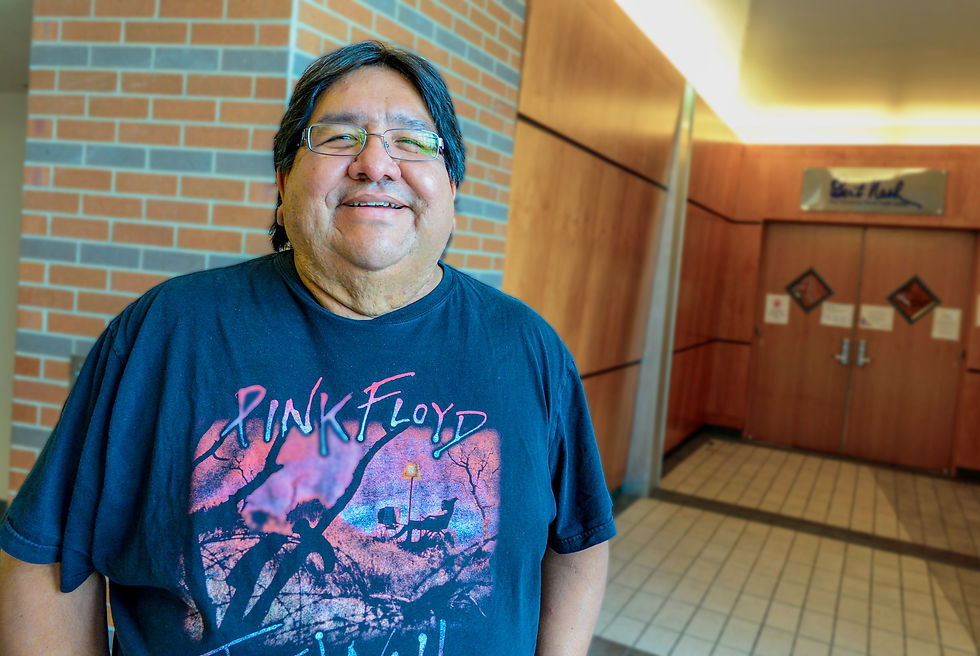
Free falling: Bert Nash staff member feels at home in the sky
Flying through the air at 120 mph, Mathew Faulk feels, well, grounded.
“Skydiving is therapeutic,” said Faulk, a member of the Bert Nash Community Mental Health Center homeless outreach team who is also a skydiver. “Not to make a pun, but it’s very grounding. I have degrees in philosophy and I tend to think about things, but when you’re skydiving you can’t really sit and think about abstract thoughts. You have to focus on what you’re doing.”
Skydiving has been a focus of Faulk’s for the past six years. That’s how long he has been jumping out of airplanes on a regular basis. When people think about taking to the skies for a trip, they probably are not expecting to jump out of the plane for a skydive. There are many adventurous activities people like to be involved in, even though not all would be able to handle the same level of risk. Also, they can cost a lot of money and skydiving is a sport not everyone who likes doing can actually do. But, here we don’t think Faulk was looking up “how much does a private jet cost to rent?” so he could jump in style, but I’m sure one day he’ll get the chance to.
He first skydived in 1995 when he was in high school in Oklahoma.
“A friend and I got the idea in our head we wanted to go skydiving the summer before our senior year,” Faulk said. “We had the notion we wanted to do something. For whatever reason, skydiving kind of stuck in our heads that that’s what we wanted to do.”
During that year Faulk made approximately 40 jumps, until he took it up again in 2009. He’s been skydiving ever since.
“Now it’s my weekend hobby and job,” said Faulk, who earns extra money by doing photography and videography – using two cameras mounted on his helmet – of customers skydiving.
“I really enjoy it,” Faulk said of his side job. “I climb out of the airplane first and then we jump at the same time. I fly around them and try to get as steady a shot as I can and as long a shot as I can, so they can have a full view
of the experience. I don’t normally deploy until 3,000 feet. I want to land quickly, so I can video the customer’s landing. Then I edit on the ground."
Faulk is a member of the team at Skydive Kansas in Osage City.
“That’s the closest drop zone,” Faulk said. “Even though it is a smaller drop zone, the owner, Jen Sharp, is extremely involved in the sport. She has a very good reputation for her safety record and as an instructor. She’s a wonderful lady. She’s done a lot for the sport.”
On a typical weekend day, Faulk will make three or four jumps, maybe five. The drop zone is only open on weekends.
Faulk has made nearly 500 jumps, all but 40 since 2009. He still gets nervous before every jump, but in a good way.
“They say if you don’t have any nervousness you should stop,” Faulk said. “There’s always a little bit of anxiety before every jump. That’s healthy. It gives you a healthy respect for what you’re doing. You’re jumping out of an airplane. People who don’t have any fear are likely not to be as vigilant as they need to be.”
Faulk’s girlfriend, Merrill Evans, a Bert Nash therapist, doesn’t share her partner’s passion for jumping out of airplanes, but she has skydived. Once. Not that she would be opposed to doing it again.
“I did one tandem skydive,” Evans said. “I was super nervous, I think like most people. But it was really pretty amazing. It was an experience I would highly recommend to everyone to do it at least once. I would probably do it again.”
Evans said she never would have considered jumping out of an airplane. Until she met Faulk.
“I totally fell for this guy,” she said. “It was the classic case of falling for this guy and I’ll get into what he is into.” For Evans, the worst part about her skydiving experience was the lead-up to actually jumping. Or falling.
“You don’t really jump out of the airplane, you fall. You’re strapped to somebody and they open up the door and you kind of rock back and forth and fall out,” Evans said. “The most nerve-wracking part was the airplane ride. I was so nervous.”
There is little margin of error in skydiving. You have to be good on your feet. And in the air.
“It is a sport that is heavily dependent upon technology and decision making, including the decision not to jump,” Faulk said. “Part of being a safe skydiver is being able to make the decision not to skydive.”
Faulk has suffered some bumps and bruises from skydiving, but no serious injuries. I’ve seen some pretty bad injuries, but those are pretty few. There are things like twisted ankles, bruises, just like any sport.”
Obviously, there is an element of risk involved in skydiving. In 2013, the U.S. Parachute Association recorded 24 fatal skydiving accidents out of about 3.2 million jumps, or 0.0075 fatalities per 1,000 jumps.
“The most dangerous things about any skydive happens after the parachute opens, because landing is the most dangerous part,” Faulk said.
Especially now that Faulk and Evans have a daughter – Vivian was born in January – Evans takes comfort in knowing her partner is a safe skydiver, even though there are inherent dangers involved in the sport.
“Yes, of course, I worry, maybe a little more now that we have a baby. But he’s not an adrenalin junkie like some people are who jump off radio towers and buildings. He doesn’t do any of that stuff,” Evans said.
Typically, Faulk will jump at an altitude between 10,000 and 13,500 feet and deploy his parachute at 3,000 feet. The highest altitude he has jumped from is 15,000 feet; the lowest is 2,300 feet.
“I really wouldn’t want to go any lower than that,” he said. “Two thousand feet is not quite half a mile. That’s not very far. When you’re flying belly to earth, your average speed is around 120 mph. At 120 mph, you can go 1,000 feet in about five, five and a half seconds. So if you’re going 120 mph and you jump at 2,000 feet, you have about 10 seconds before you hit the ground.”
Some people who skydive only do it one time, to cross it off their bucket list. Others, like Faulk, get hooked on flying through the air, and find it exhilarating and calming at the same time.
“There’s nothing like it,” he said. “One thing I like about skydiving as a sport is everybody works together. No one is trying to outdo anyone. People are trying to make a successful skydive together.”