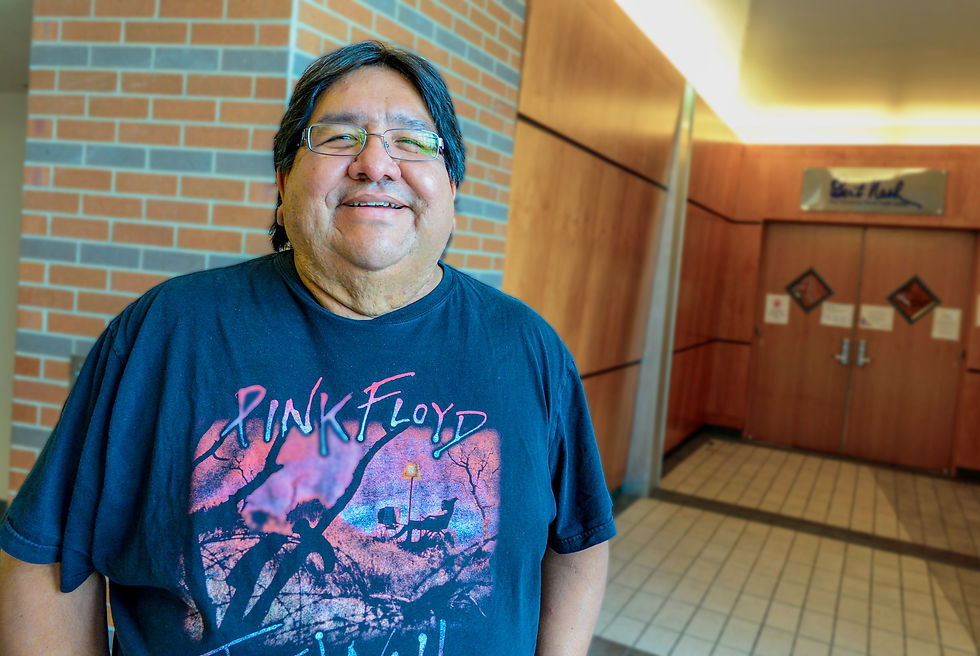
KU football great has message for athletes: It’s OK to ask for help
Note: September is Suicide Awareness Prevention Month. Anyone struggling with thoughts of suicide should call the National Suicide Prevention Lifeline at (800) 273-8255 or (785) 841-2345. You can also get connected to the Crisis Text Line by texting KANSAS to 741 741.
Tony Sands spent his football career running away from opposing players. But he couldn’t run away from himself.
Football was his identity. But once his playing days were over, Tony, the second all-time leading rusher in Kansas history, was faced with figuring out who he was after football.
“My life was programmed around football,” said Tony, whose 396 yards against Missouri in 1991 still stands as the Kansas single-game rushing record.
That transition from star football player to former football player was difficult.
“Those days of having a stadium full of people rooting for you, those days were over," Tony said. “It took me to some dark places. No one knew that I was close to taking a gun and ending my life. Because I didn’t reach out to get help. Not that I didn’t have people I could have talked to, but I was scared to open up to them.
Now I always tell people, there is always somebody, you can talk to.”
In his new book, “I Was Before My Time,” Tony shares his story — overcoming depression and suicidal thoughts and creating a healthy, successful life after football.
“First I had to accept that I had a problem that I needed to get corrected. What turned it around for me was my wife telling me that my life was bigger than sports, that sports was just part of my life,” Tony said. “When I started speaking to athletes, I found myself healing myself.”
Football had taught Tony about mental toughness, to tough it out, to push through. That was the culture. “You can’t be an athlete and not be tough,” Tony said. “So, we thought being tough was if I have something bothering me, I have to keep it inside and man up. Versus saying, I don’t have all the answers and I need help.” Being Black also made it hard for Tony to talk about his mental health.
“Mental health was a taboo subject throughout the Black community,” Tony said. “We were always told that what goes on in the home stays in the home, even if you might be experiencing some mental health issues. You’re crazy, you have some screws loose upstairs, your elevator doesn’t go all the way up, these were some of the stigmas that were attached to mental health.”
As far as athletics, the sport with the highest rate of suicide is football.
“Football is more of that gladiator, you’re in a coliseum-type mentality, and we take on that personality,” Tony said. “But there’s a difference between mental toughness and mental health. When I was going through my situation, even those closest to me were not aware of what I was going through. I was afraid if I did reach out, how it was going to be perceived.”
Tony has a different message for athletes he talks with now.
“Even though we are successful athletes, at the end of the day we are humans who deal with issues just like everybody else. No matter how high you climb, no matter what you achieve, no matter how much money you make, it doesn’t eliminate you from day-to-day problems that everyone goes through. Everybody has something they are dealing with,” Tony said. “I want to be out in front of this and let athletes know that it is OK to ask for help.
“At the end of the day, it’s about saving lives.”
Tony Sands will share his story during Drawing Up A Play For Mental Health: A Panel Discussion On Mental Health In Athletics. The event, sponsored by Holman Needle & Ink, will be held in person from 7-8 p.m. Monday, Sept. 20 at the Lawrence Arts Center. An option to attend virtually is also available. To register, go to www.bertnash.org/panel2021.
Other panelists include Darrell Stuckey, KU Director of Football Operations; Samantha Van Hoecke, KU pole vaulter, Daniel Hishaw, KU football player, Dr. Mary Fry, KU School of Sports Psychology professor; Audrey Trowbridge, Lawrence High School track coach and Lawrence Free State social worker; and Katie Coldham, Bert Nash Center WRAP (Working to Recognize Alternative Possibilities) therapist.