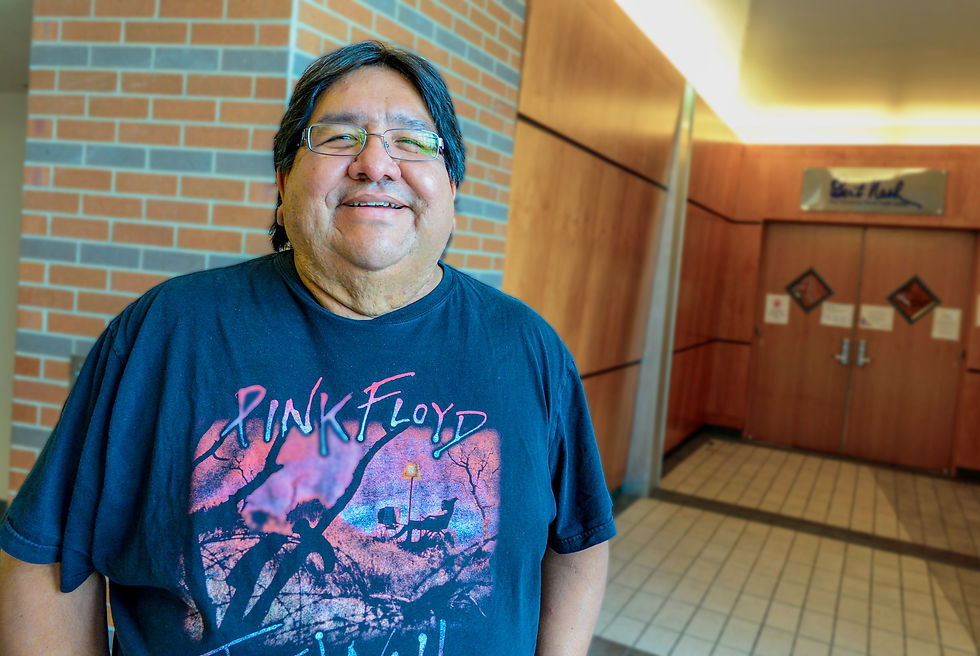
Minority Mental Health Month highlights awareness and struggles
The pandemic impacted the physical health and wellbeing of people in different ways. Many people became more concerned about their mortal life and how to take care of it.
It also impacted the mental wellbeing of communities in different ways. Anxiety for catching the illness ran rampant. Paranoia at the sound of a cough was high. Stay-at-home orders and the inability to seek out friends left many isolated and alone in times of need.
That was especially true for the BIPOC (Black and Indigenous People Of Color) communities. “The past year and a half with the pandemic have been pretty intense for people of color,” said Alex Kimball Williams. “You’re talking about people that are very familial in their cultures. The pandemic took away that chance to congregate.”
July is Minority Mental Health Month. It’s a time to bring awareness to the unique struggles that racial and ethnic minority communities face regarding mental health.
“There are very big differences between different racial groups in terms of how they relate to mental health,” said Alex, who is the Health Equity Planner for Lawrence-Douglas County Public Health.
Alex identifies as Alaskan Native and Black. Her husband is white.
“For the Native population, we definitely view health as being holistic and mental health is connected to the spiritual and physical parts of us,” Alex said. “For the Black community, you aren’t going to see suicide be among the top 10 causes of death. For Black Americans, you’re going to see homicide, you’re going to see other kinds of violence and tragedy. For a lot of Black folks, their mental health is deeply impacted by police brutality and oppression.
This is a community that prides itself on being survivors.”
But that can be a barrier to talking about mental health.
“As a community that takes pride in our ancestors for making it through so that we could be here today, to admit that that’s something internal going on that we need help with, it goes against that identity of being resilient and tough,” Alex said.
There can be other barriers to receiving mental health services. Language can be a barrier. So can the lack of health insurance.
But if organizations recognized by the federal government, non-profits, and public entities can take USDA business and industry loans, and use these loan proceeds to build or improve services and facilities that provide health care, then that might bring some attention and help to the people needing these health care services.
“There are huge unknowns and of course the fear that they are going to be further traumatized through white therapy,” Alex said. “Things that have happened historically have bred mistrust of medical and mental health practitioners.”
People of color oftentimes prefer to be seen by medical or mental health professional who is a person of color.
“People of color like to see someone who looks like them,” Alex said. “Like when I was working with the vaccination clinics and I would go around and talk with people of color, the first question would be, did you get vaccinated? Just getting representation from people who look like them, talks like them, people they can trust, that definitely goes a long way as far as spreading awareness around certain communities.”
**********************
In some ways, Jasmin Moore’s mental health actually improved during the pandemic.
“My mental health improved because all of my external commitments stopped because the world slowed down.” Jasmin said. “We have two boys who were 6 and 9 at the time and all of a sudden there were no practices and no games. My general stress level decreased because of that.”
In other ways, though, her mental health suffered.
“I was working from home full time, my husband was working from home full time, and we had two kids who were schooling full time from home,” Jasmin said. “We were all trying to figure out how to function together.”
Indeed, this is a similar story seen throughout the world right now. Some have found themselves more and more drained by the day from the efforts needed to juggle all of this, and while the physical side has options to help alleviate this, mental health is always a little less straightforward to handle.
Jasmin identifies as Black and also as a biracial woman. She is the mother of two Black boys and the wife of a Black man.
“So, the way I experience the world is through those experiences and identities,” Jasmin said. “That has a significant impact on my mental health.”
Jasmin is the Sustainability Director for the City of Lawrence and Douglas County. Her work focuses on the economic impact, the environmental impact, and the human impact of city and county policies and programs. The past year was especially challenging.
“This past year, being a Black woman, doing work on climate change and the climate crisis, and doing work on the pandemic, in addition to experiencing all the stressors related to the pandemic, it was a lot,” Jasmin said.
Economic and environmental disparities were intensified during the pandemic, which affected people’s mental health, particularly for the BIPOC communities.
“When systems are disrupted, everybody doesn’t experience the effects the same way,” Jasmin said. “We know, historically, in our communities, the decisions that have been made by local governments have disproportionately impacted communities of color. We also know that during the pandemic, our communities of color, our low-income communities, our communities with disabilities, our rural communities, were impacted disproportionately. That’s why when building a climate action plan for the city and the county we are intentional about bringing racial equity into that process.”
This past year was difficult for the BIPOC communities not only because of the pandemic, but also because of the trauma of racial injustice and systemic racism.
“When we think about why we are engaging in this dialog of health equity, we all can agree that the pandemic exposed health inequities and forced us to rethink our intentions and actions around nearly every aspect of our lives,” said Erica Hill, the Director of LMH Health Foundation Finance & Strategic Initiatives, LMH Health Equity, Inclusion and Diversity and President of the Lawrence Board of Education. “We were challenged to examine what was in place within our organizations and the broader community – what was working and what wasn’t.”
Strides have been made in recent years to destigmatize the subject of mental illness and treatment, but many people in underrepresented communities face internal stigma when it comes to getting help. Erica, who is Black, said there are many factors that contribute to the stigma.
“Seeking mental health care could be viewed as a weakness, running counter to the survivalist or resilient mentality in our culture,” Erica said. “Reluctance to seek both physical and mental health care may be attributed to a general distrust of the medical community because of historical injustices, such as being exploited by the medical community in the name of medical advancement. To gain trust medical communities could start by listening and seeking to understand and being intentional about addressing racial inequities and health disparities.”
Having a communitywide strategy to advance healthy equity is a key to sustainable, meaningful change.
“Advancing health equity should be a foundational element of our community, meaning it should be at the core of all decisions, policies, programs and strategic plans,” Erica said. “I’m fortunate to serve alongside my peers as a Unified Command Equity Impact Advisor to ensure our community is centering equity in our COVID responses. I am optimistic that this structure can be used as a model to continue this work beyond COVID. As a community, we have to be intentional about addressing inequities. Being intentional will get us on the right pathway to get us closer to where we want to go, and who we want to be as a community.”
***********
With a background as a football player and coach and in law enforcement, Myrone Grady is accustomed to projecting strength and toughness.
“I’m a football guy, I always have one more rep in me,” said Myrone, who is Black and a lieutenant with the Lawrence Police Department. “Coming from a guy who played college football, who’s been a college football coach, and then got into law enforcement, there’s a lot of big personalities, egos and alpha male personality that are involved in those activities.”
But even tough guys need help sometimes. For Myrone, one of those times came when his mother died more than 10 years ago.
“I maybe didn’t believe that anxiety and that kind of thing were real until it happened to me,” Myrone said. “When I went to work, I could always block that stuff out. I could fake it so well. When I was going through my difficulties, nobody really knew. But I was struggling. People I worked with had no idea. I caught myself kind of being upset that nobody could see it, but I couldn’t be mad because I had hidden it so well. That was eye opening for me. If you know you’re struggling, it’s up to you to get help. You have to be selfish with your own self-care.”
For Myrone’s own self-care and mental health, he went down what he called a “path of self-discovery.” He adopted a lifestyle of mindfulness and meditation that helped him get through the tough time he was experiencing.
“I tell people all the time, I feel like meditation saved my life,” he said.
This past year, during the pandemic as well as with the presidential election and the social unrest happening, Myrone’s mental health again began to suffer.
He decided he needed to step back from social media and focus on things that were the priorities in his life, like his family.
“During the pandemic, and specifically with all of the stuff that was going on this time last summer, one thing I did for my mental health was I unplugged,” Myrone said. “I deleted my Facebook account. I focused in on things that would help ground me and center me, the things that I could control. I started a garden, more than anything for my mental health. I went back to a simpler life where there wasn’t so much social media pressure to live up to whatever expectations others have of you. That was key for me. Nobody forced me to do it; I just felt like it was time. I was finding myself not being happy by something I chose to use.”
Myrone has returned to social media, but on his own terms, he said. He’s also continued to practice mindfulness and meditation. And he’s learning to open up more about how he’s feeling.
“Now that I’ve gotten older, it’s gotten easier to have those conversations,” Myrone said. “We have to be able to talk about the hard things and to help each other get through it. That’s all part of being part of a community of like-minded people who care for one another.”
************
Sonia Jordan had a baby – her third – in January 2020. She planned on being off work for eight weeks for maternity leave.
Then the pandemic changed everything.
“I came back early from maternity leave to work on the pandemic,” Sonia said.
Sonia, who is Hispanic, returned to work part time four or five weeks after her daughter was born. But thanks to her agency’s infant at work policy, Sonia was able to bring her daughter to work.
“I was glad for the opportunity to have her here at work, but it was really challenging to do all of the work that was being required at the time because of the pandemic and to have a baby strapped to my chest,” Sonia said.
Sonia is the director of informatics for Lawrence-Douglas County Public Health. Her department did the epidemiology work during the pandemic, as well as the disease investigation, isolation and quarantine orders, contact investigation, and health statistics.
Prior to the pandemic, Sonia was someone who had anxiety as well as depression and minor obsessive compulsive disorders. The pandemic intensified all of those feelings.
“I definitely noticed my anxiety was highly increased, but I also noticed that my OCD tendencies were really increased as well,” Sonia said. “I recognized what was happening, and I have strategies for how to manage it, but I couldn’t summon the willpower to do those strategies. I felt very helpless. Everything felt like it was too hard. I felt like I couldn’t ever get to a manageable level. That was a hard period of time, and I think it was a hard period of time for a lot of us.”
Sonia turned to a book by Dr. Stephen Illardi, titled the “Depression Cure.” Dr. Illardi is a professor of psychology and clinical researcher at the University of Kansas.
“I started to slowly but surely to implement a lot of the things he talks about in the book,” Sonia said. “The hard thing when you’re depressed is you don’t really have a lot of motivation to be doing self-improvements. At first, I didn’t think it was going to work, but at some point, the clouds began to lift. For me, there was a pattern of recovery where I felt like I was making progress, but it wasn’t linear or direct.”
Sonia’s mental health is doing better, but it is still a process.
“I think there are a lot of people who are struggling. It should not surprise that our populations of color would struggle more with their mental health because these are populations that are already under a huge amount of stress from things like systemic racism,” Sonia said. “We have inequities and disparities existing in our community based on our ethnic populations. All of that becomes more intense during times of high stress like a pandemic.
We need to give each other just an immense amount of grace in that process of trying to figure out what life looks like in the post-COVID era.”