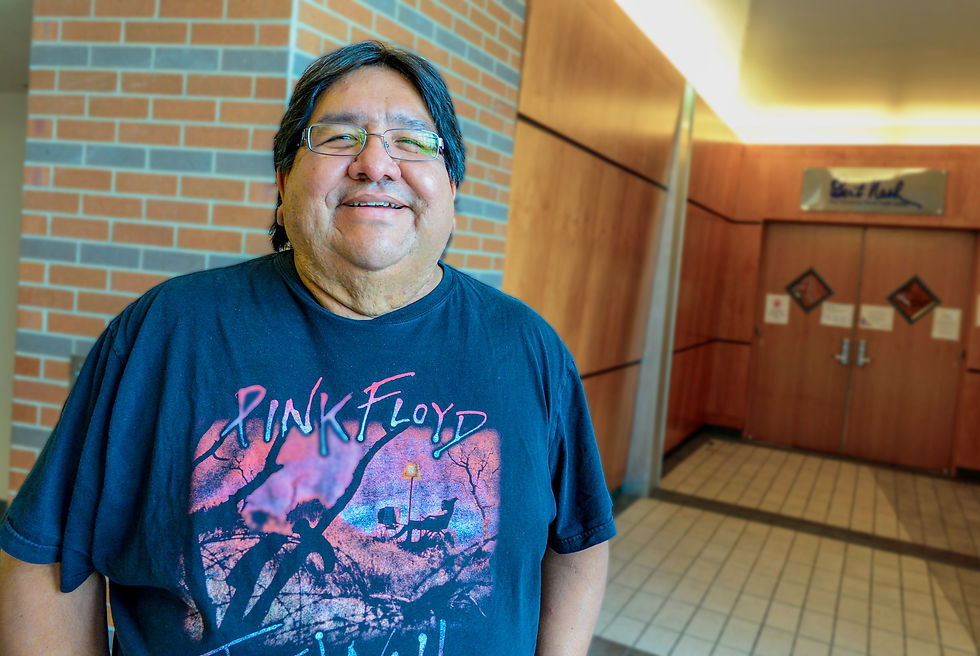
Overcoming anxiety: Professional and family support help man deal with disorders
Three years ago, Jeremy was practically afraid to leave the house. The outside world seemed too scary.
“It had gotten to the point where he was pretty much living on a cot in his dad’s house,” said Amy Warren, who was Jeremy’s therapist after he started coming to the Bert Nash Community Mental Health Center at the end of 2011.
Jeremy first noticed his obsessive-compulsive disorder tendencies when he was 15. The older he got, the worse the OCD became. To the point where when he would wash his hands, he would scrub them 256 times.
Why 256 times?
“I was ritualistic. I would put the soap on my hands, run them under water and repeat 256 times,” Jeremy said. “I had given myself a number, because I felt like if I didn’t I could wash my hands for hours.”
He would spend hours in the shower and use six gallons of bleach to wash his body.
“My hands were always burned from the bleach,” he said. “It really irritated my skin. It was pretty bad.”
Jeremy also had a phobia about bugs, especially roaches. The fear of bugs kept him from venturing outside very much or entering public places, like restaurants, where he thought there might be roaches. He would drive around for hours considering what restaurant to eat at, worried the people preparing the food would touch it with their hands. The phobia even affected what he would wear.
“He wouldn’t wear shoes that tied, because the laces could touch the ground,” said Warren, who was the Adult Outpatient Program team leader at Bert Nash at the time.
“I would wear Velcro shoes,” Jeremy said.
Physical contact was avoided. He wouldn’t touch his brother or his two nephews because he was aware his brother had a problem with roaches in his apartment.
“I wouldn’t hug them or anything,” Jeremy said. “I felt bad about it, because my nephews are like my kids.”
Jeremy liked to read, but he was afraid to go to libraries because the books had been in people’s homes and he worried there were roaches in the homes where the library books had been.
Jeremy knew he didn’t want to live like this, but he couldn’t help it. He was miserable. He thought about killing himself.
“It kept getting worse and worse. I went through my own private hell,” Jeremy said. “I wondered if I would ever get past this and have a normal life. I just felt like I was in a state of anxiety all the time.”
It was a difficult period for Jeremy. His mom, who lives in Lawrence, knew he needed help.
“At one point we thought we might lose him before we could get him help the kind of help he really needed,” Jeremy’s mom said.
She searched the International OCD Foundation website for a place where her son could find help. She found it at the Obsessive Compulsive Disorder Institute at McLean Psychiatric Hospital in Belmont, Mass.
“They gave him the tools to get started on getting better,” Jeremy’s mom said. “Belmont really kickstarted things for him.”
Another turning point came when Jeremy started participating in the Intensive Outpatient Program at Bert Nash. Then in December 2011, he started seeing Warren, who headed up the Center’s anxiety disorder services at the same time.
Jeremy started confronting his fears. The exposure group at Bert Nash would “do exposures” every other week to help people face and overcome their fears. This exposure can help those who need to face their fears and get through them step by step. Some patients might also want to go for natural alternatives like using cannabinoids. CBD products can help in easing symptoms of anxiety. It also seems to have helped many patients suffering from anxiety and stress. However, natural alternatives are not only restricted to these products. The various intake form of cannabinoids includes CBD vape oil, creams, and gummies. When choosing this option, make sure you are using the appropriate instrument. Since medical marijuana has gained so much attention, many people are now looking for accessories and other paraphernalia to consume it, such as dab rigs and bongs. However, you would be better off consulting your physician before using them.
“I used to have a fear of anything bug-related. I couldn’t touch a picture of a roach, like in a book. I couldn’t even touch the word roach,” Jeremy said. “I started out by touching the word. Once I got better with that, I started touching pictures of roaches in books.”
“We even got these plastic roaches; they were life-like, and he was able to put them on his body,” Warren said. “That was a pretty big step,” Jeremy said.
Andrew Jensen, a Bert Nash specialty case manager who works with Jeremy, said, “I’ve appreciated working with someone committed to recovery. He has been very open to trying different methods of exposure in and out of the office.”
Jeremy started reading again. He would even pick up a used book. He walked the downtown sidewalks on Massachusetts Street. He hugged his nephews.
“It takes a lot of courage to go out and face your fears,” Warren said. “Jeremy deserves so much credit, and so does his mother. She is such an advocate for him.”
Change has come incrementally for Jeremy. It has been a process. But also a life-changing one.
“He has made great strides. He’s way better from when he was when he went to McLean,” Jeremy’s mom said. “He told me once he couldn’t see a light at the end of the tunnel, that there was no future for him. He’s so much better now.”
Family support has been an important part of Jeremy’s recovery. For many, they do not have this element -- having a support net alongside these is also very important.
“I’m not saying we haven’t been frustrated with Jeremy, because we have,” his mom said. “This is a really hard thing for families to deal with. It takes a great deal of patience. But there has been a lot of support around Jeremy. I believe that’s been really helpful.”
Even with all of the improvements he has made, this year hasn’t been easy for Jeremy. One of the difficult challenges he had to face was the death of his father.
“After his father passed away, we found that cot in the garage Jeremy used to live on. It was hard for me to think his life had been reduced to that. He threw the cot away. It was like a symbolic gesture,” his mom said.
Jeremy is continuing to work on expanding his world.
“This year has been particularly stressful with my dad dying,” Jeremy said. “But I can honestly say, even with everything that has happened, I’m a lot better than where I was three years ago when I started coming to Bert Nash. It’s good to know you can get help and things will get better, even for me, when I thought there was no way I was going to get better.”
For information about anxiety disorder services at Bert Nash, call 785-843-9192.