Takin’ it to the streets: Bert Nash team reaches out to the Lawrence homeless population
With their long hair and long beards, they look like rock stars.
But they don’t act like it.
No limos or fivestar hotels for this band. But almost any day of the week you can find them at the Lawrence Community Shelter, or along the banks of the Kansas River, or in the downtown district.
Or wherever the homeless are.
Since 2006, a team of trained case managers from Bert Nash Community Mental Health Center, through a partnership with the city of Lawrence and a federal grant, has been reaching out to the city’s homeless population.
“The ultimate goal is to help people obtain and maintain housing,” said Bert Nash’s Sharon Zehr, who supervises the team. “To do that, you have to help them get jobs, deal with their substance abuse, deal with mental illness, or deal with domestic violence, or whatever assistance they need.”
The city provides about $165,000 annually to help fund the homeless outreach team.
“Bert Nash’s programs, including the homeless outreach team, provide a beneficial resource to our community,” said City Manager David Corliss. “The city has supported Bert Nash and its various programs for many years because we see the value in physical and mental health services.”
Homelessness is not a single-issue problem. There are typically other factors involved when people find themselves on the street, including issues with substance abuse that would require treatment like can be found at these West Coast Recovery Centers, as well as trouble finding and staying in work.
The one common denominator, though, is they don’t have a place to call home.
“We work with pretty much anybody, as long as they are homeless, or at risk of becoming homeless, and they have a need for service and we can help them,” said Brad Cook, the senior member of the Bert Nash homeless outreach team.
Cook has been involved with the homeless outreach team since the beginning. He has had a passion for working with the homeless since he was a student in social welfare at the University of Kansas.
“It’s a worthy cause,” Cook said of his chosen profession. “The homeless is a population that is always marginalized by the world, and I think they need the help.”
Other members of the team – Mathew Faulk and Namaste Manney – are in it for similar reasons. “The world needs more people doing this kind of work,” Faulk said.
Manney, the newest member of the team, said, “I have had experience being a low-income mother and a single mom myself, so I really enjoy being able to help families and single moms connect with services and try to keep their heads above water.”
Another member of the team – technically, he’s his own team – is David Tucker, or Tuck, as he is called. Funding for his position is paid through a federal grant called PATH (Projects for Assistance in Transition from Homelessness), and targets the homeless who are mentally ill.
Tucker’s motivation for being involved in homeless outreach is simple.
“I feel like everybody deserves a fair chance,” Tucker said. “To me, it is a social justice issue. Someone who is having trouble in their life should be treated as a human being and still given respect.”
What is Tucker’s least favorite part of the job?
“Taking people to jail,” Tucker said after providing transportation for a homeless man who was ordered to report to the Douglas County Jail. “At least I’m not the one arresting them. I’m just trying to get them to where they need to be.”
Transportation is a challenge for many homeless people. Getting them from Point A to Point B is an important part of the job description for the homeless outreach team.
“Getting people to their appointments, getting them out looking for jobs, we just try to get people where they need to go,” Tucker said.
“We do a lot of driving,” Cook said. “We rack up a lot of miles.” Members of the team are always on the lookout for homeless people.
“Outreach is a big part of the job,” Tucker said. “We’ll spend a lot of time just walking on Massachusetts Street.” One of the people who members of the homeless team reached out to was Troy Frank.
When Frank was on the street, members of the homeless team brought him food or gift cards for a local grocery store or took him to a food pantry.
“They would come and find me,” Frank said. “Otherwise, I wouldn’t have known anybody.” For Frank, the Bert Nash services were a lifeline.
“You find that there are good people who care,” Frank said. “That there’s support out there.” As of April 9, 2012, the 51-year-old Frank has a place he can call home.
With help from the Bert Nash housing assistance program – a cooperative effort with the Lawrence Housing Authority – Frank now lives independently in a one-bedroom duplex. The program allows people who have a mental disorder to live on their own in the community. Bert Nash case manager Eddie Velez provides ongoing support for Frank.
“It’s been good,” Frank said. “Having a roof over your head and a place you can call your own. You start to feel like a person again.”
Massachusetts Street and the busy downtown district are areas frequented by the homeless, though not as much as when the former homeless shelter used to be located near downtown. The popular downtown district is an area frequented by the homeless because of the crowds of people, which mean opportunities for panhandling, even though the city has an ordinance against “aggressive panhandling.”
While many downtown shoppers try to avoid panhandlers, members of the homeless outreach team seek them out.
“We’re always on the lookout for homeless people,” Tucker said. “That’s a big part of the job is networking inside One thing members of the homeless outreach team don’t do is judge. The people they work with are in the homeless community.”
“They didn’t choose to be homeless,” Cook said. “I don’t think anybody wakes up and says, oh, I want to be homeless. It’s just the path they have gone down.”
And it is a hard road.
“Probably five or six people die a year who we work with,” Cook said. “People who are homeless have a higher rate of mortality than other people. Poverty kills you.”
Mental illness or substance abuse or both can go hand-in-hand with homelessness. “We deal with substance abuse and mental health problems all the time,” Cook said.
“Not only are we dealing with, say, someone who had a drug problem, but the reason it is so exacerbated is because there are also these other social issues going on,” Faulk added.
The team’s connection to Bert Nash offers homeless clients access to the center’s mental health services.
“Having the homeless team employed by the Bert Nash Center helps facilitate access to services for clients and provide available professional consultation as needed,” said Eunice Ruttinger, Bert Nash adult services director.
For members of the homeless outreach team, it’s important to gain the trust of the people they work with. They do that by showing genuine concern and with small acts of kindness.
“When I meet someone, I’ll bring them food or coffee and just hang out with them,” said Tucker, who regularly gets food from a food pantry, like Lawrence-based Just Food, and takes it to places where homeless people are staying. “You have to let them know you can be trusted and let them know you are not here to harm them in any way. I am just the guy who brings them food. Eventually, it helps them open up so we can work on things like their medication or housing.”
It also helps that members of the homeless outreach team look the part. Tucker describes his beard as his people filter.
“It allows people to say, hey, there’s a guy with a long beard. I have a long beard. We have something in common,” Tucker said. “This is a job you can’t do dressed in business casual.”
“I think it absolutely helps,” Cook said of the appearance of the male members of the homeless outreach team. “I think it makes us much more approachable,” Faulk said.
With their long hair and beards, the male members of the team receive stares when walking the streets of Lawrence.
“We have people ask us all the time if we are in a band,” Cook said.
“They like to pretend they are in a band,” Manney, the only female member of the team, said.
Members of the homeless outreach team are available during walk-in hours from 8-10 a.m. each weekday at the Bert Nash Center, 200 Maine St. The walk-in clinic, which opened in 2012, increased accessibility for those requesting help.
“Anyone can show up,” Tucker said.
Members of the team also spend considerable time at the new community shelter, located next to the Douglas County Jail, and regularly make the 15-minute drive back and forth between the shelter and the Bert Nash Center.
The new shelter, opened in November 2012, is double the square footage of the old one and increased the number of beds from 75 to 125.
But there are never enough beds for everyone who needs one.
“The last two to three years, we’ve had 200 to 300 homeless people,” Tucker said. “They’re camping, they’re doubling up, they’re staying with family or friends, and they’re sleeping in cars.”
In 2011, the Bert Nash homeless outreach team worked with 106 people. The number increased to 195 in 2012. Last year, the team helped 70 individuals and 17 families find housing.
“We do the best we can with the resources that are available to us,” Cook said.
Team leader Zehr is proud of the work the team members do for some of the least fortunate in the community.
“I love the team,” Zehr said. “They have been doing this a long time, and to work with this population for that long can be really difficult. The burnout can be really high. But they are very passionate.”
Team members provide a support system for each other.
“We talk a lot among ourselves, and that helps a lot,” Manney said. “We try to be as supportive of each other as we can,” Faulk added.
Working with the homeless can be emotionally draining. It can even be hazardous duty.
“Oh, yeah, absolutely, I’ve had people get upset with me sometimes,” Tucker said. “I’ve had knives pulled on me. I’ve had bottles thrown at my head. I’ve had a gun pointed at me. It happens."
But members of the Bert Nash team do what they do because they believe everyone deserves a helping hand, especially those who may be considered outcasts.
“Everyone is deserving of respect,” Tucker said. “You have to be able to approach someone no matter their circumstances. I feel that’s all this job really takes.”
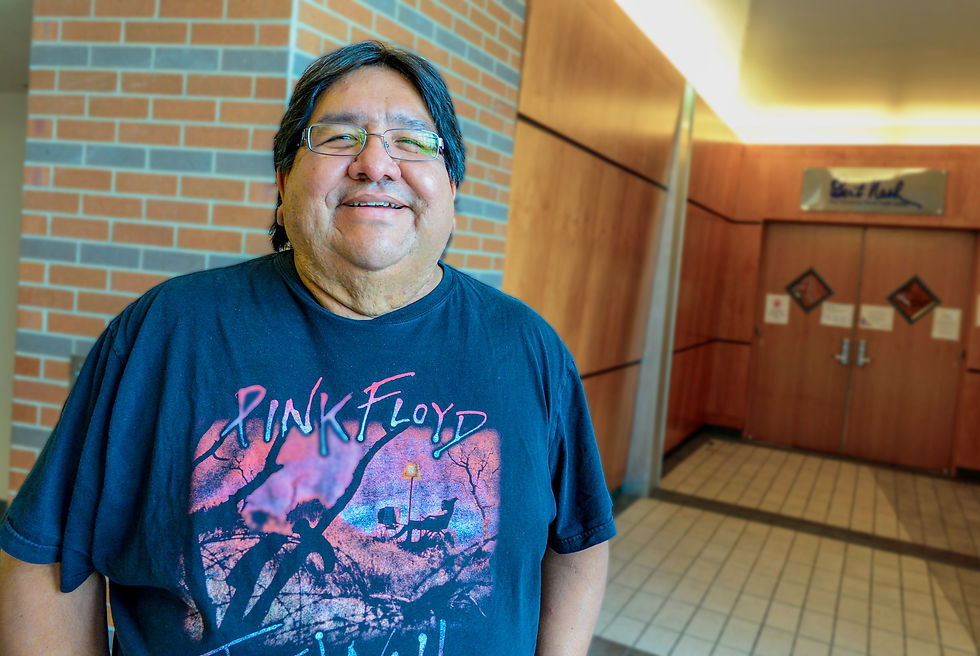
David Tucker is a member of the Bert Nash homeless outreach team. He also works at the Lawrence Community Shelter.
Sharon Zehr oversees the Bert Nash homeless outreach team.
Namaste Manney enjoys being able to help families and single moms connect with services.
Brad Cook is the senior member of the homeless outreach team. He has had a passion for working with the homeless since he was a student in social welfare at the University of Kansas.
Team member Mathew Faulk says, “The world needs more people doing this kind of work.”