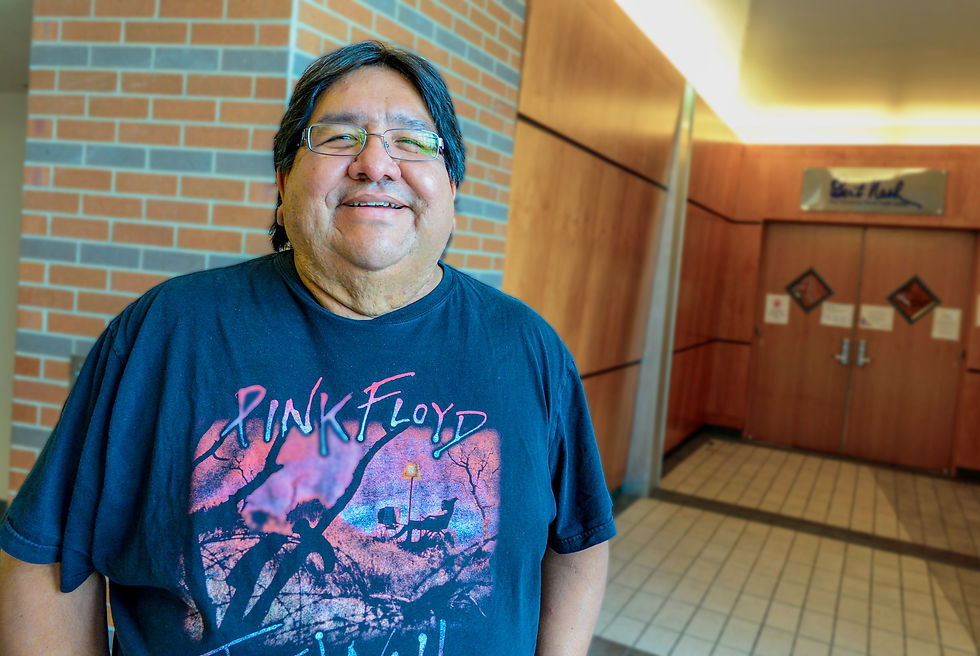
That’s a WRAP: Charlie Kuszmaul calls it a career
Charlie Kuszmaul, who retired in November, spent 25 years on staff at the Bert Nash Center. For most of that time — 19 years, to be exact — he was the driving force behind a program that places a mental health therapist in Douglas County schools.
Known as WRAP, which stands for Working to Recognize Alternative possibilities, the in-school therapy program has touched the lives of “probably 10,000 kids” over the past nearly 20 years, said Kuszmaul, who joined the Bert Nash Center staff in 1991.
Six years later, in 1997, Kuszmaul started the WRAP program, thanks to funding from a federal grant. That first year, the program placed a master’s-level clinician in both high schools in Lawrence and a half-time position at the alternative high school.
“There was a big push at the time to do group therapy, so I started doing groups at the high schools,” Kuszmaul said. “It was from there that I made the connections in the district and we were able to move the concept forward.”
WRAP goes where the students are — in the schools. The WRAP therapists work in cooperation with school counselors, teachers and administrators.
“Kids don’t want to go to the mental health center, because that’s where the ‘crazy people’ go,” Kuszmaul said. “So bringing the WRAP workers to the schools is of vital importance. They become more integrated in the students’ lives, and when you do that it’s much more reasonable to do an intervention, because you’re there and you’re available.”
Over the years, the program’s staffing of a therapist in Lawrence and Douglas County schools has fluctuated, depending on funding.
“We started seekingother funding over the years, whichallowed us to expand the program into other schools,” Kuszmaul said.
At one point, the WRAP program was in every school in Douglas County. Currently, WRAP is in both high schools in Lawrence, all four middle schools, six of the highest-need elementary schools (with half-time positions), a one-quarter time position at Bishop Seabury, and at the Eudora Elementary School. Bert Nash also oversees the secondary therapeutic classrooms at the Bert Nash Center and Southwest Middle School, a partnership with the Lawrence School District. WRAP also provides group therapy at the Douglas County Juvenile Detention Center.
Anna Stubblefield, assistant superintendent of educational support for the Lawrence School District and former principal at Liberty Memorial Central Middle School, said the WRAP program was a huge benefit to the school. “Bert Nash would make sure there were no drops (in services for students),” said Stubblefield, who was principal at Liberty Memorial Central Middle School from 2008 to 2012. “It fills that gap. There are certain things where the school has our limits. I really appreciate that Bert Nash filled in the gap where we didn’t have those resources.
When some of the kids needed more support, Bert Nash could provide those one-on-one resources. That was a life-saver.”
The WRAP program wouldn’t have been with possible without the cooperation and partnership of the school districts in the county, as well as local foundations like Douglas County Foundation and the Sunflower Foundation. And, “of course, the mental health center has put in significant amounts of money at various times over the years,” Kuszmaul said.
Before the WRAP programstarted, Kuszmaul had laid thegroundwork at both high schools, making contacts and connections that were instrumental in the launching of an in-school therapy program. WRAP workers are available to help with the behavioral, emotional, family and psychological problems students can have.
“What we’re trying to deal with are those kids who have significant programs with emotional and psychological functioning,” Kuszmaul said. “Because how kids function in school will be an indicator of how they will function in life.”
With the WRAP program, there are no obstacles to students receiving services. Students can be referred to WRAP by a parent, teacher, administrator, therapist or they can self-refer. WRAP is available to all students in the schools where the program is offered and there is no charge for the service.
As Kuszmaul liked to say about the WRAP program, “We don’t cost money; we save money,” citing the down-the-line costs of troubled students who don’t get help that can show up in the form of teen pregnancy, substance abuse or incarceration, all of which are a financial drain on the system.
Two years after the WRAP program was started, the school shooting at Columbine, Colo., occurred.
“When that happened it scared the heck out of people, because everybody was perfectly aware it could happen anywhere,” Kuszmaul said. “There were a lot of studies done after that and they found the best thing that could happen was to have someone in the school, like a WRAP worker, before something happens.”
While decreases in funding has forced the WRAP program to be scaled back at times, thebehavioral, emotional and psychological needs of students haven’t diminished.
“The number of suicide assessments we do in a year … it wouldn’t surprise me if we did a hundred a year with kids who are serious about killing themselves, and these are kids of all ages,” Kuszmaul said. “The WRAP workers does a whole range of interventions. We develop a relationship with students so that they will tell you about things, like whether they are considering killing themselves or someone else.”
Students who stay in school, who stay out of trouble, who stay on the path to becoming functioning adults can be a measuring stick of the WRAP program’s success. Perhaps the ultimate benchmark is the lives that are changed…and saved. Kuszmaul called it the exponential effect.
“It’s kind of like Mental Health First Aid (a training program similar to CPR that teaches mental health awareness), we don’t know how many people we’ve saved,” Kuszmaul said. “But we know lives have been saved.”
For Charlie Kuszmaul, that was his life’s work.