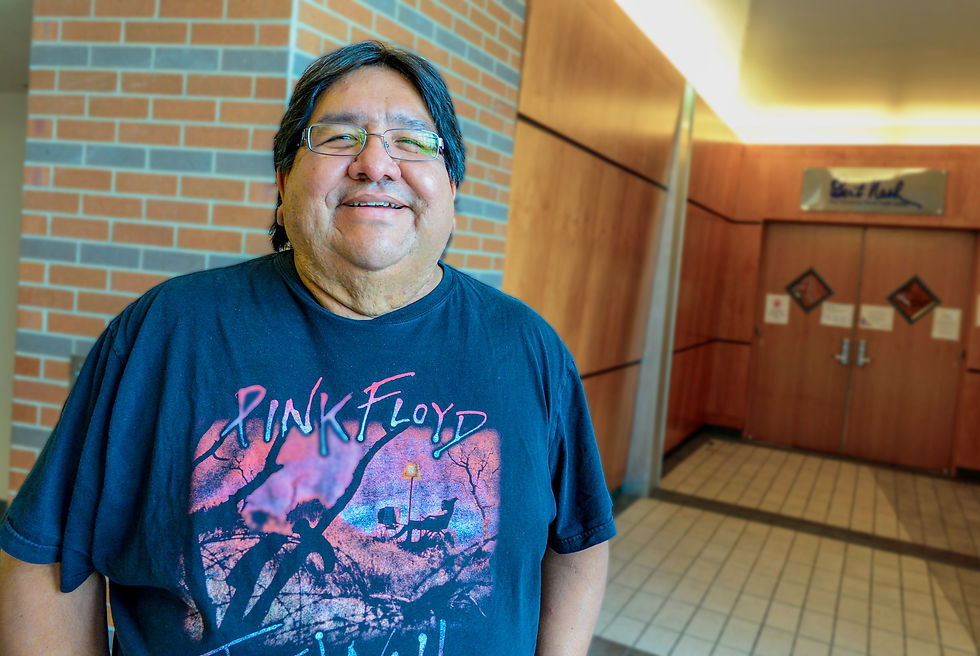
‘The life I have now’
It used to be, Jim Kytasaari had it all backward. He would treat loneliness with isolation. He would treat depression with a depressant.
It was a vicious cycle.
“There was no way out of it,” Kytasaari said.
But there was a way out. And that way out led Kytasaari to the Bert Nash Community Mental Health Center. But, first, Kytasaari hit rock bottom.
“I totally had a crash about six years ago,” Kytasaari said. “Everything fell apart.”
Kytasaari was homeless at the time. He was estranged from his family, including his three sons. “I was literally a mess,” he said. “I was miserable. I knew I had to do something.”
Eventually, Kytasaari was diagnosed as type 1 bipolar with psychotic features.
“I’ve dealt with mental health issues most of my life,” he said. “It really manifested when I got into my late 20s.”
Kytasaari’s path to recovery occurred incrementally, one step at a time. There was no quick fix, even though he wished for one.
“You want that pill that will take everything away,” he said. "But it has been a process. It’s still a process.” The process included individual and group therapy, as well as a healthy diet, exercise and socialization.
“I was in deplorable health,” Kytasaari said. “I weighed 400 pounds. I had out-of-control diabetes. People asked me why I didn’t take better care of myself. I said, well, when you want to kill yourself on a regular basis, your physical health is not your biggest concern.”
As despondent as Kytasaari was, his responsibilities to his children helped to keep him going. “Even though I had struggles, that kept me pushing forward,” he said.
Kytasaari’s family was there for him when he couldn’t function. His sister provided support and encouragement, as did his parents, who helped care for his sons when he wasn’t able to do it.
There were times when the issues in his life would get him down or become overwhelming, and Kytasaari turned to alcohol.
“I self-medicated myself,” he said. “But then one day, the party stops and the pain starts. As much as I knew drinking was bad for me and as much as I knew it was affecting everything in my life, I couldn’t stop.”
Kytasaari attended Alcoholics Anonymous meetings; along with the therapy services he received at Bert Nash, which included individual and group therapy. Group therapy helped Kytasaari become less isolated and challenged him to open up about the real issues going on in his life.
“I suffered from terminal uniqueness,” he said. “I thought I was the only one who has this. No one else can understand my feelings. I used to put this brave face on. When I would go to a group, I would gear up just to fake it until I got through the meeting.”
Over time, being around others who were dealing with similar issues helped Kytasaari see he wasn’t alone.
“As I would go to these groups, somebody would say something, and I would nod my head,” he said. “You make a connection. I would get more out of it by watching other people’s successes.”
Medication, therapy, socialization, AA meetings, exercise, a healthy diet, all of these things played a role in Kytasaari’s recovery. He deserves most of the credit, said his former therapist, George Wanke, Bert Nash IDDT (Integrated Dual Diagnosis Treatment) team leader.
“It’s a testament to him, more than anything else,” Wanke said. “He was amazingly focused on getting himself back into physical shape. It was a metaphor for everything else that he did.”
Kytasaari was in bad shape when he came to Bert Nash.
“He didn’t have much going for him in life,” Wanke said. “When he came here, he was on death’s doorstep. But there’s hardly a person I can think of who has changed as much of his life as he did. He changed everything there was to change. I don’t think there was anything about his former life he wanted to keep. It was a holistic change, the whole thing. As a client, he’s admirable in that just about everything he could do to improve his life he was willing to do. It just doesn’t get any better than that.”
One of the other keys to Kytasaari’s recovery was being honest, both with himself and others. “Not just telling the truth, but being open and honest about what is going on in my life,” he said. He also had to learn to practice acceptance, especially about his own life.
“I still struggle with body image issues, but I’m not afraid to live anymore,” said Kytasaari, who has lost 130 pounds. “All I used to do was regret the past and fear the future, so I never lived in today. I used to have this utopian idea that when this situation is better, or this relationship is better, I’ll be better. It just doesn’t work that way. Once I accepted what I had and was able to learn coping strategies, I found there is hope and recovery.”
Over time, Kytasaari restored his relationships with his children and his family. But again, it was a process.
“It has taken a long time to restore those relationships, and I don’t blame them. I had totally cut myself off,” he said. “But as I got better and came out of the shame I had been living in, I was able to reconnect with them. I didn’t really get my old life back. I got a life that is what it is now.”
Kytasaari is grateful for the services he received at Bert Nash that helped him build a new life. They put him on the path to a new way of thinking — and living.
“If not for Bert Nash, I know I would have ended up in jail or institutionalized,” Kytasaari said. “The people at Bert Nash cared for me before I could care for myself.”