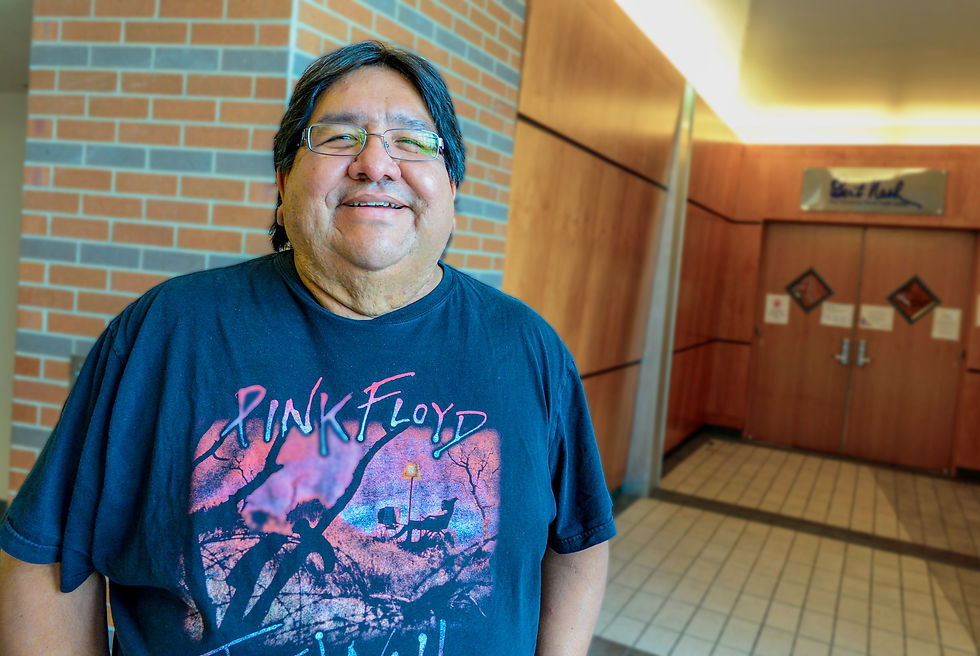
Whenever Bert Nash Center is closed, the after-hours screeners are on duty
When the lights have been turned off, the doors locked, and the staff at the Bert Nash Community Mental Health Center has gone home, there are mental health professionals still on duty.
One of those groups is the after-hours screeners.
“This team is an extension of our daytime Access Center and has all the necessary administrative backup required to support their work,” said Eunice Ruttinger, Bert Nash adult services director.
The primary responsibility of the after-hours screeners is to evaluate if a person is suicidal or homicidal and determine if hospitalization is required.
“A screen is an assessment of whether a person needs to be hospitalized voluntarily, involuntarily, or if they can be safely diverted to outpatient services,” said Ganis Himes, who supervises the Bert Nash after-hours screeners. “We respond to all kinds of situations. There are people who are suicidal. There are people who are homicidal.There are people who are having trouble caring for themselves.”
Whatever the case may be, requiring a patient to be hospitalized when he or she doesn’t want to be is not an easy decision.
“I never like making someone go involuntarily to a hospital,” Himes said. “That’s not something I like to do. It’s my least favorite part of the job.”
But sometimes it’s necessary.
“I always tell people what can look really bad one day can look completely different another day,” Himes said. “The thing is to get to that next day.”
Being an after-hours screener can make for some long days or nights.
“We do screens any hour of the night,” Himes said. “The screeners work really hard.”
When an emergency call comes in, it is usually picked up by a 24 hour medical answering service professional. He then contacts the after-hours screener on duty. The screener has one hour to reach the hospital, the jail, or wherever the screening will take place. There are two after-hours screeners on duty at all times. Screeners are available from 5 p.m. to 8 a.m. every day, including holidays.
“We’re on duty whenever Bert Nash isn’t open,” Himes said.
A screen, on average, takes about an hour and a half. But some screens can take from three or five hours. “The reason for that is sometimes it’s difficult to locate an accepting hospital with bed availability,” Himes said.
Most frequently, after-hours screens are done at Lawrence Memorial Hospital, but they are sometimes done at the Douglas County Jail or Douglas County Juvenile Detention Center. In 2012, the Bert Nash after-hours screeners conducted almost 900 screens.
“We see Bert Nash as an excellent resource in mental health, so we really rely on their screeners,” said Ryan Jackson, director, LMH emergency department. “I believe we all benefit because we have a good collegial relationship with Bert Nash. We find their screeners helpful to us and sensitive to their clients’ needs.”
Himes is one of the 10 after-hours screeners. She also works part time in the Bert Nash Access Center, which is available for screenings during weekdays.
“We used to have like five after-hours screeners, but because of the increase in the number of screens, we had to add screeners,” Himes said. “We have seen a lot of suicide attempts, particularly in the last year. I attribute it to the economy and people losing almost everything. We’re seeing people who are psychotic. We’re seeing increasing numbers of older patients. And we’re seeing substance abuse cases.”
Himes began screening in 1991. She’s been doing it longer than any other Bert Nash screener.
“I just like it,” Himes said. “There is a lot of crisis intervention, which I really like. That’s my background. And I like that it’s always different.”
Not that being an after-hours screener is easy work.
“People who like crisis work like to do this. It’s a tough job,” Himes said. “It takes a special person to be a screener. It takes someone who has clinical skills, but also someone who has investigative skills. They have to be a good listener and someone who can ask good questions. They have to be someone who is not threatening and who is calm. It also takes someone who is able to make a tough decision the client may not like.”
The after-hours screeners, who undergo a thorough training process, work in cooperation with medical personnel and law enforcement.
“The doctor is the ultimate authority,” Himes said. “What we do is we talk to the patient, we talk to family if they are available. We try to coordinate the best possible, safest plan.”
A patient may not appreciate what an after-hours screener is trying to do at the time, but the screener has the patient’s best interests in mind.
“We always try to take the approach we’re there to help. We’re not trying to punitive. We’re there to come up with the best possible plan,” Himes said. “Over the years, I’ve only had a couple of people who were upset about an involuntary screening.”
Typically, after a situation is stabilized, the patient is grateful for the efforts of the after-hours screeners.
“Most people thank you, because they realize they were in a bad spot and they needed to go to a hospital. It feels good when you screen someone and they’ve gotten help,” Himes said. “I’ve had people come up and hug me and say thank you for making me go to the hospital. I didn’t want to go, they say, but I’m better now.”