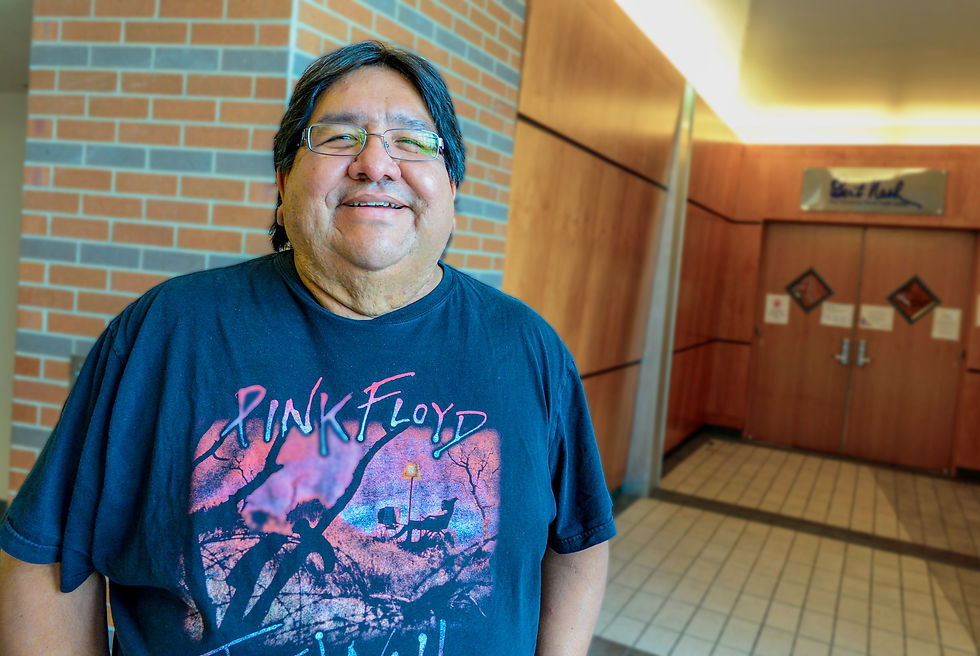
WRAP program reaches children where they are — in the schools
When Charlie Kuszmaul heard about the shooting at Sandy Hook Elementary School in Newtown, Conn., like everyone, he was appalled. But he wasn’t surprised.
He knew the possibility existed for the same horrible act to occur at any school in the country. Including here.
“When Columbine happened I was at Lawrence High School and everyone there was aware that it just as easily could have happened in Lawrence, or anywhere,” said Kuszmaul, who is coordinator of Bert Nash Center's WRAP Program(Working to Recognize Alternative Possibilities).
Twelve students and one teacher were killed in the shooting at Columbine High School in 1999.
In today’s volatile social climate, the reality is that schools must be prepared in all ways possible for threats and emergencies of different kinds. This, unfortunately, also includes being ready to tackle any life-threatening circumstances like bleeding or fatal injuries.
It is a painful fact that school staff and maybe even students must be trained in first aid and the premises must be equipped with a proper school bleeding kit that allows for an immediate response in the case of such an event.
Apart from that, incidents like school shootings have far-reaching repercussions, discussions surrounding which are equally important. Thus, the need for initiatives like WRAP.
Two years earlier, WRAP was started in Lawrence’s two high schools.
WRAP is a Bert Nash Community Mental Health Center program that currently operates in two of the city’s four middle schools – Liberty Memorial Central and South – both Lawrence high schools and the Eudora schools.
“The mission of the program is to make students as effective as they can be at school,” Kuszmaul said.
WRAP workers, who are master’s-level clinicians, are available to help with the behavioral, emotional, family, and psychological problems students can have. In other words, the kinds of issues schools may not be prepared to handle.
“Schools are not well equipped to deal with those problems,” Kuszmaul said. “Schools are equipped to educate children. We’re asking our school system to do something it was not set up to do.”
Emotional and psychological issues can be a deterrent to students succeeding in the classroom.
“What we’re trying to deal with are those kids who have significant problems with emotional and psychological functioning,” Kuszmaul said. “Because how they function at school will be an indicator of how they will function in life.”
The WRAP program was set up to place mental health clinicians in the schools, because that is where kids spend the majority of their time.
“Teachers aren’t trained to deal with mental health issues, like depression and anxiety, which can get in a student’s way of learning,” said April Ramos, the WRAP worker at Free State High School. “So, we are here to help students with whatever is getting in the way of them being successful students, which later translates into being productive, contributing society members.”
Having WRAP workers on site helps to avoid the stigma often associated with mental health issues.
“Kids don’t want to go to the mental health center, because that’s where the ‘crazy’ people go,” Kuszmaul said. “So bringing the WRAP workers to the schools is of vital importance. They become more integrated in the kid’s life, and when you do that, it’s much more reasonable to do an intervention, because you’re there and you’re available.”
WRAP workers work in concert with school counselors, teachers and administrators.
“WRAP is in the schools to serve an unmet need,” said Amy Brown, WRAP worker at Eudora High School. “The schools provide a great forum for identification, prevention and intervention.”
Anna Stubblefield, human resources director for the Lawrence School District and former principal at Liberty Memorial Central Middle School, said the WRAP program was a huge benefit to the school.
“Bert Nash would make sure there were no drops (in services for students),” said Stubblefield, who was principal at Liberty Memorial Central Middle School from 2008 to 2012. “It fills that gap. There are certain things where the school has our limits. I really appreciate that Bert Nash filled in the gap where we didn’t have those resources.
When some of the kids needed more support, Bert Nash could provide those one-on-one resources. That was a life-saver.”
Especially in those situations when the school’s resources are limited.
“She (WRAP worker Deb Keary) would step in and fill the gap,” Stubblefield said. “Deb was very good about sharing information (with the appropriate school personnel), but she gave the students a safe place to go. From the students I interacted with, they felt like it was a safe haven.”
School personnel and WRAP workers may have different areas of expertise, but they desire the same end result -- healthy, functioning students.
"Is behavior getting in the way of learning? That’s what teachers are interested in,” said Valerie Giedinghagen, WRAP worker at South Middle School. “We have the clinical perspective to say (to a teacher) what they could do to help a student.”
In the beginning, a WRAP worker was assigned to both Lawrence high schools, and eventually every Lawrence school.
“WRAP began as a program to help with kids who were truant,” said Giedinghagen, WRAP worker at South Middle School. “Truancy is a pretty good predictor of family stress and the WRAP program naturally evolved from there, because truancy is not the only predictor. In my school, free and reduced lunches have doubled over the past few years. That is another good predictor of stress for families and students.”
Because of the loss of funding since the program’s inception, WRAP had to be scaled back. There is no longer a WRAP worker in the Lawrence elementary schools and two of the middle schools. Nor are there WRAP workers in the Baldwin schools, as there used to be.
The hope is to restore funding so WRAP can be available in all Douglas County schools.
Shannon Jones, a member of the 2013 Leadership Lawrence class, is working with Bert Nash CEO Dave Johnson to find sustainable funding for the WRAP program. She said the benefits of WRAP and finding funding to sustain the program are a “no-brainer.”
“I first heard about WRAP when Dave came and spoke to our Leadership Lawrence class on wellness day. That was my first exposure to WRAP,” Jones said. “When I heard about WRAP and heard that funding had gone away, there were some of us in the class who wondered what we could do to start the conversation of what we can do to get this back in the schools.”
Then Jones attended a Discover Bert Nash session, which is a one-hour virtual tour about the programs and services offered by Bert Nash and the impact they have on people’s lives.
“That’s when Charlie (Kuszmaul, WRAP coordinator) did his presentation,” Jones said of the Discover Bert Nash session. “I walked out of that meeting saying the loss of funding for the WRAP program couldn’t be allowed to happen.”
For Jones, the mother of two elementary students, the Newtown shooting was heartbreaking and alarming. “With Newtown just happening, it’s obviously on all our minds,” Jones said. “My youngest is in kindergarten and that guy would have walked right down her hall and things would be very different for our family right now.”
Jones joined forces with fellow Leadership Lawrence class member Leslie Soden and made a presentation to the rest of the class about finding long-term, sustainable funding for the WRAP program.
“That’s our goal, so that whenever have to be at risk of it going away again," Jones said.
The WRAP program is available to all students and there is no charge for the services.
Many of the students who participate in the WRAP program come from low-income families. The ability to pay can be a hindrance to finding help from other sources.
With the WRAP program, there are no obstacles.
“We don’t put any barriers on the way we see kids,” Kuszmaul said.
Students can be referred to a WRAP worker by a parent, teacher, administrator, therapist, or they can self-refer. WRAP is a preventative program designed to reach students as early as possible and give them necessary life skills.
“This is a way of paying it forward,” said Janice Storey, Bert Nash child family services director.
The down-the-line costs of troubled students who don’t get help can show up in the form of teen pregnancy, substance abuse or incarceration, all of which are a financial drain on the system.
“We don’t cost money; we save money,” Kuszmaul said of the WRAP program.
Former Liberty Memorial Central Middle School principal Stubblefield said WRAP provides another layer of emotional and psychological support in the schools, and she would hate to see the program go away.
“Students know the Bert Nash people,” Stubblefield said. “Bert Nash was the consistent component in their lives. If that were removed, it would mean there would be a chance some students may not come up on our radar, because we always go to the students with the greater need. So to lose that connection, some borderline kids could slip through the cracks.”
While it is sad it took the Newtown shooting to shift attention on the importance of mental health services, it has focused awareness on the need for preventative programs like WRAP.
While decreases in funding forced the program to be scaled back, the behavioral, emotional and psychological needs among students haven’t diminished.
In fact, the need may be greater than ever.
The Newtown school shooting in December was the second deadliest in U.S. history, after the 2007 shooting at Virginia Tech University. Twenty schoolchildren and six adults were killed at Newtown. In the shooting at Virginia Tech, 32 people were shot and killed and 17 wounded.
Thankfully, there have been no such school shootings in Douglas County. But no school is immune from the possibility of a Newtown or a Columbine.
WRAP workers deal with a range of issues, from anxiety and depression to substance and sexual abuse and even suicide.
“The WRAP worker does a whole range of interventions,” WRAP coordinator Kuszmaul said. “It’s just about as heavy a lifting as you can do as a therapist. We’re talking about developing a relationship with someone so that they will tell you about things, like whether they are considering killing themselves or someone else.”
Which has happened.
However, the student didn’t follow through on the suicidal or violent thoughts. Instead, the student confided in a WRAP worker first, and the clinician was able to defuse the life-threatening situation. The situation was resolved without anyone being harmed and without most people even being aware of the student's plans.
A student who is contemplating suicide or even murder is an extreme case, but there are countless examples where a WRAP worker has helped a student who was dealing with a serious emotional or psychological issue.
“We don’t discharge people out of the WRAP program,” program coordinator Kuszmaul said. “We don’t have an end date. We have kids who started in the first grade and are still involved in the program in high school, which is great." Students who stay in school, who stay out of trouble, and who stay on the path to become functioning adults can be a measuring stick of the WRAP program’s success.
But perhaps the ultimate benchmark is the lives that are changed … and saved.
“We can check grades and things like that, but the real question is, ‘How are you doing?’ What about the kid who was suicidal and is still alive?” Kuszmaul said. “We might consider that a fairly significant success.”